

Ron Arad, civil engineer
Arad Bedek Bayit
Building inspection engineers are seen as the contractors' enemies. Lawsuits over construction defects cost contractors in Israel tens of millions of shekels a year.
Over the years we have found defects that are serious, safety-related, and symptomatic of more than poor supervision: some show that a foreman was barely on site at all.
Here are two examples out of thousands.
In a new building in the large Ramat Aviv block (a luxury seafront project), while inspecting the common areas in the pump room and stairwell, we found... nothing less than a bucket cast into the concrete pour:
Needless to say, this is a serious defect: it significantly weakens the concrete and shows that no rebar was placed inside it either. A defect like this points to negligence in how the project was managed, and indeed the same project turned up other serious problems: rainwater penetrating the underground parking garages in multiple places, and non-conformities with the contract, such as missing awnings over some of the apartment windows.
In another project, on Em HaMoshavot in Petah Tikva, an unusual defect traced back to a lack of coordination between the electrical contractor and the foreman. In one apartment, the switch boxes had been roughed in too close to the doors to install properly. 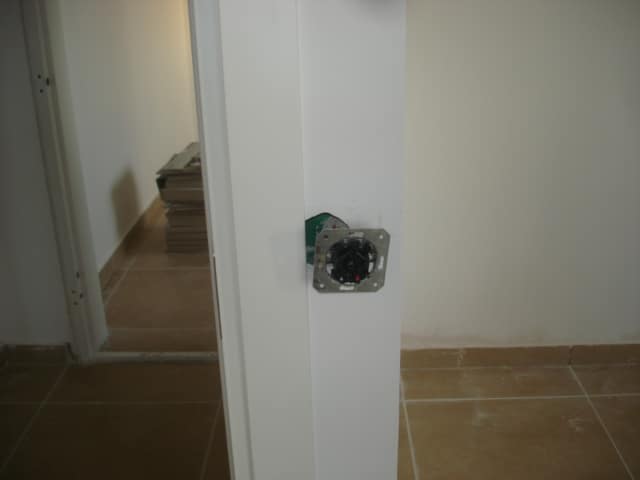
Worth noting: this was a relatively high-end build by a quality contractor. Even so, one subcontractor's failure to coordinate with the foreman produced a defect that should never have happened.
In another case, the contractor tried, with some nerve, to shift the blame onto the resident. The resident had asked to swap the standard toilet for a wall-hung one and paid extra for it. The change made the toilet protrude further than planned, and the door could no longer open a full 90 degrees without hitting it.
Was the resident really at fault for choosing a wall-hung toilet without realizing it would protrude and block the door? Of course not. Under proper procedure, a resident requesting a change works with a professional representing the contractor, usually a changes architect or similar specialist, whose job is to explain the implications of the requested change and offer solutions.
Here, the fix could have been simple: for a small extra cost, a toilet model that does not protrude could have been ordered instead.
Finally, a serious safety defect in a building in Kiryat Ono: the fire hose reel was not connected to the water supply. Needless to say, without our inspection, this would only have come to light if the hose had ever been needed to fight a fire in the building.
To sum up: when a contractor hands over an apartment, the resident is entitled to have every construction defect a home inspection engineer finds fully repaired. A home inspection (bedek bayit) for a new apartment, and fixing hazards promptly, heads off a chain of nuisances that would otherwise follow.
If the exterior cladding, for instance, is not done to standard or is sloppy in places, waterproofing problems will surface in a wall and leave it unable to resist dampness, say by the building's third winter.
That dampness then forces substantial repairs much sooner than residents ever expected, along with the frustration of the costs that come with them.
Waterproofing is just one problem. The real issue is that most residents have no idea how wide the range of possible defects in their home actually is: defects that sometimes go well beyond future expense or nuisance, into matters as serious as safety, even the risk to residents' lives.
The engineers of Arad Bedek Bayit, led by building engineer Ron Arad, whom courts appoint as their own expert on construction defects. The company has been inspecting apartments and buildings since 2001. Engineer Ron Arad · More about the company