

Flooring and cladding can have many problems, whether the tiles are ceramic, porcelain granite or stone. They can be divided into two types: safety defects and aesthetic defects.
Safety defects in flooring and cladding
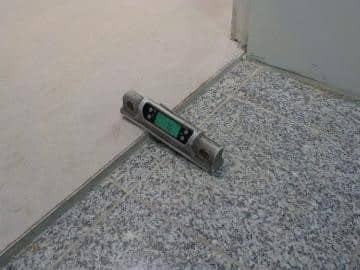
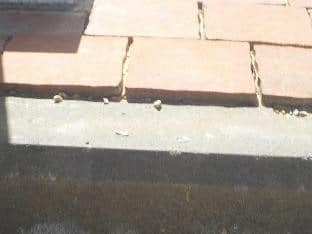
Here are a few examples:
- Height differences between tiles: Israeli Standard (SI) 1555 Part 3 allows a height difference of up to 1.5 mm between adjacent tiles, and up to 1.8 mm when the tiles are large. A larger difference is not only an aesthetic flaw but also a safety failure, because people can trip on it. A case like this from the lobby of a building in Ramat Gan is described on the page defects we found in buildings.
- Cladding tiles that were not properly bonded, for example in the main lobby or a floor lobby, can come loose and fall. This is sometimes seen in the tiles around the elevators.
- Cladding tiles without joints of at least 3 mm and without expansion joints 6 mm wide: in this situation the cladding system cannot contract and expand properly, and the tiles may come loose.
Aesthetic defects in flooring and cladding
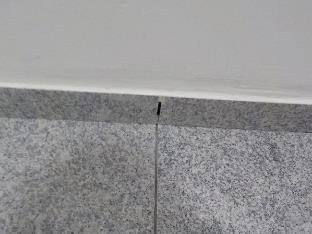
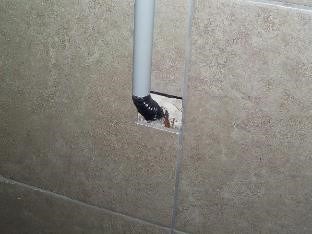
Here are a few examples:
- Damp stains in stone: early dampness (for example during construction) under stone tiles in the lobby creates stains around the edge of the tile ("televisions"). In most cases there is no way to get rid of the poor appearance this gives the lobby flooring, which is the "face" of the building. Contractors often try to polish the tiles to reduce the visual damage, but since the dampness penetrated the tile from below upward, this is of little use. The real, and painful, solution is to replace the tiles.
- Broken tiles, usually at the corners. There is hardly a building without broken tiles, and sometimes it seems this is allowed and reasonable. But Israeli Standard (SI) 314 for tiles allows only tiny chips of 0.6 mm.
- Grout that was applied poorly in the joints.
More about flooring defects on the page flooring defects.
The engineers of Arad Bedek Bayit, led by building engineer Ron Arad, whom courts appoint as their own expert on construction defects. The company has been inspecting apartments and buildings since 2001. Engineer Ron Arad · More about the company