

We find defects in every building we inspect. Some are obvious, and some are small and look marginal, but their effect is far greater than their size. Here we have collected a few cases from inspections of common areas: what we found, why it matters, and what the solution is. You can read about the buildings themselves on the page buildings we have inspected, and about the inspection on the page common areas inspection.
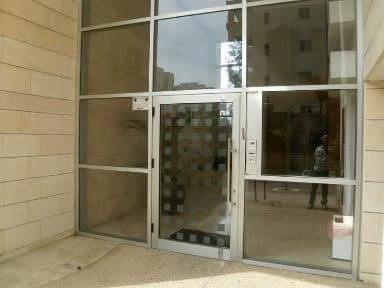
A lobby door that blew open in the wind and hit a resident, Modiin
In a project in Modiin, a main lobby door and a secondary lobby door were designed without taking into account where the doors stand relative to the wind directions. The result was a situation in which opening the main door on a stormy day could cause real injury.
And that is what happened. The building's security cameras recorded an elderly woman being struck by the door, which had swung open with force because of the wind on a stormy day, and falling.
You can read about the solution, a wind barrier or sliding doors, on the page lobby door.
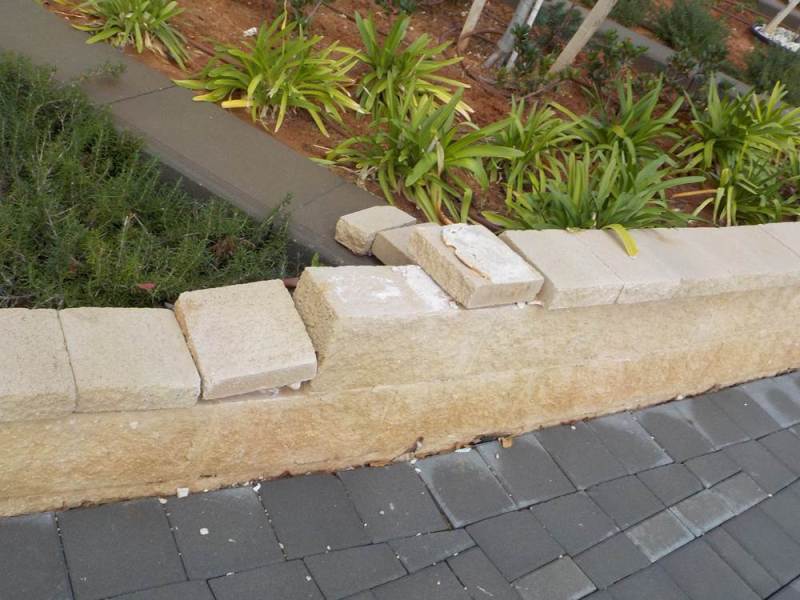
A stone wall coming apart because of poor foundations
A stone wall outside the building is coming apart because of poor foundations.
The foundation of every structural element is the basis of the design. Low walls in the common area are sometimes not given much importance, and nobody makes sure they have suitable foundations.
The result: first cracking appears (usually a stepped crack), and at a more advanced stage the cladding stones start to fall.
Beyond the foundations, expansion joints must of course be installed along the wall, and the tiles and the coping must be anchored so that tiles do not fall.
A cladding stone that fell from a height of about 30 meters, Kiryat Ono
In a 15-story building in Kiryat Ono we found that the stone cladding had been installed contrary to Israeli Standard (SI) 2378. As a result, a cladding stone fell from a height of about 30 meters. The stone had been glued on as a finishing touch after the scaffolding was taken down, but it was not anchored with a screw as the regulations require. By a miracle it did not hit anyone.
More about this on the page exterior cladding in a shared building.
A pump room without a slope to the drain, Ashdod
The inspection of a residential building in Ashdod revealed that the floor of the pump room had a faulty slope that did not lead to a drain.
What this meant: water, which is always present in a pump room, did not flow to the drain but ran out of the pump room straight into the residents' private storage rooms. Following the inspection the flooring was replaced, and the storage rooms were saved.
Height differences in the lobby flooring, Ramat Gan
In the inspection of a high-rise residential building in Ramat Gan we found that the floor tiles had been laid with significant height differences between them.
Israeli Standard (SI) 1555 Part 3 allows a height difference of only 1.5 mm, and in certain cases 1.8 mm. In this building we found height differences of up to 2 mm, a difference that can cause people to trip. More about this on the page flooring and cladding.
Defective stone cladding in the lobby of a luxury building, Haifa
The main lobby is the entrance to the building. Every resident or guest who walks in immediately notices the wall cladding.
In a luxury building in Haifa we found beautiful, high-end components in the main lobby, but the stone cladding was full of flaws that made the lobby walls plainly unsightly. The flaws included holes, tiles broken because of incorrect sorting, and poor polishing.
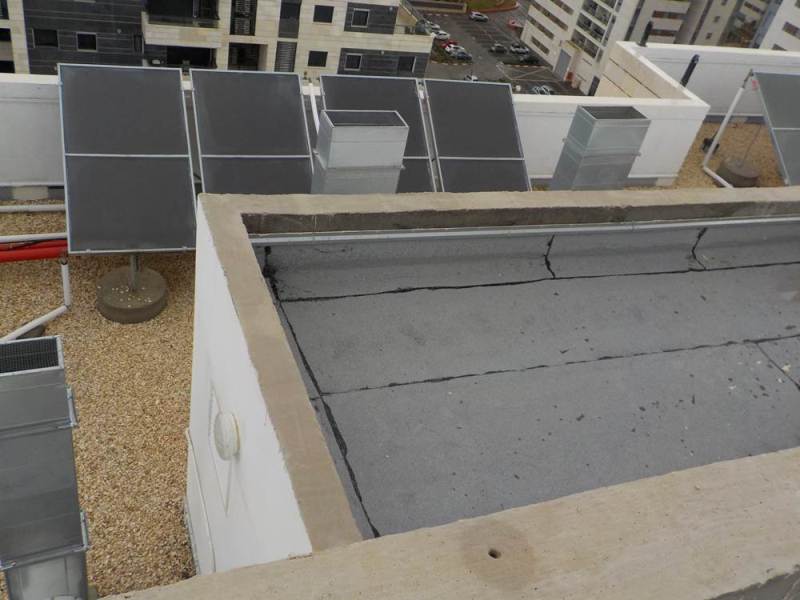
Water penetration around pipes on the roof, Netanya
One of the hardest components to waterproof is the point where piping passes through the roof floor, and the roofs of residential buildings have many of these.
Israeli Standard (SI) 1752 requires that every pipe passing through the roof be fitted with an additional bent pipe (a "walking stick" sleeve, makel saba) to protect against water penetration. But that is not enough: under the same standard, the waterproofing between the "walking stick" and the floor must surround the whole pipe, up to a height the standard defines.
When we inspected the roof of a building in Netanya we found dampness that had penetrated into the rooftop apartments in the area of the pipes, because the work did not match the standard.
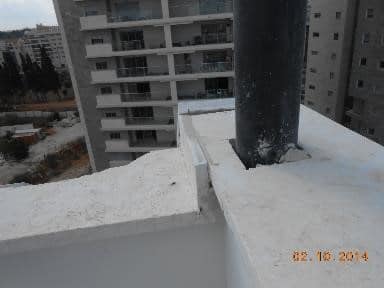
Poor sealing around a pipe on the roof, Kfar Saba
What is the effect of poor sealing around a pipe on the roof? Is it a "minor" defect?
The defect itself is not serious, and it most likely comes from negligence and lack of attention. But its effect is far greater than its size.
In the inspection of the common areas of a building in Green Kfar Saba (Kfar Saba HaYeruka) we found poor sealing around an air pipe coming out of the roof parapet. It is a small detail, but water that gets in around the pipe will seep straight to the floor below, into the penthouse. There, when the rains come or in the season after, dampness problems will appear in the ceiling and walls, damaging the paint and the furniture.
In the end someone will start looking for the source of the dampness, and unnecessary waterproofing work may be carried out, when all that was needed was to seal the pipe, at a cost of about NIS 200. And we have not even mentioned the distress of wet walls and of a struggle with the contractor or with the building committee.
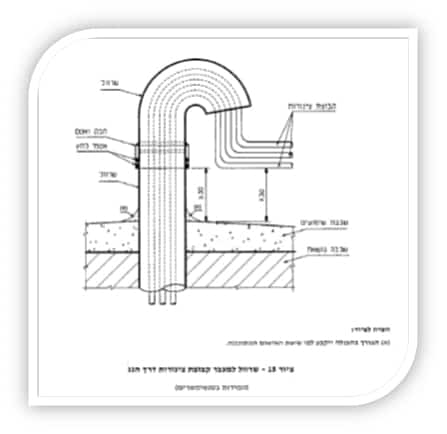
Large construction defects are obvious, but finding small defects like these in an inspection, while the residents still enjoy the contractor's full warranty and he is willing to make repairs, is the smartest step of all. More about roof waterproofing on the page construction defects in roofs.
A garbage chute that spreads odors, Ramat Aviv
The inspection of a luxury residential building in Ramat Aviv revealed, surprisingly, that the garbage chute was not working properly and caused unbearable odors on the floors.
It turned out that the ventilation system lacked circulation, and the fan could not draw the air out of the garbage compartments on the floors. You can read about the requirements for a garbage chute on the page garbage chute.
Air conditioners in the underground parking garage, Tel Aviv
This is an example of something that should never have happened, in the underground parking garage of a new residential building in Tel Aviv.
Air conditioners for the stores on the ground floor were installed in the garage. The contractor sold the stores, and he also installed the air conditioners. The garage is shared by the stores and the apartments. This is an exceptional case, not something that is done in new buildings.
These are the hazards created by installing the air conditioners in the garage:
- The units give off a great deal of heat, and in the summer months it is impossible to stay in the garage, even for a short time.
- A danger in case of fire: the smoke extraction fans were not designed to remove the smoke and the additional heat created.
- The heat given off by the air conditioners can cause a fire or contribute to one.
- A noise nuisance from the units.
The repair: moving the air conditioners to a dedicated air-conditioning yard, including the appropriate approvals. Cost of the repair: about ₪30,000.
More about underground parking garages on the page the underground parking garage standard.